

+918042753310

Currently it only shows your basic business info. Start adding relevant business details such as description, images and products or services to gain your customers attention by using Boost 360 android app / iOS App / web portal.

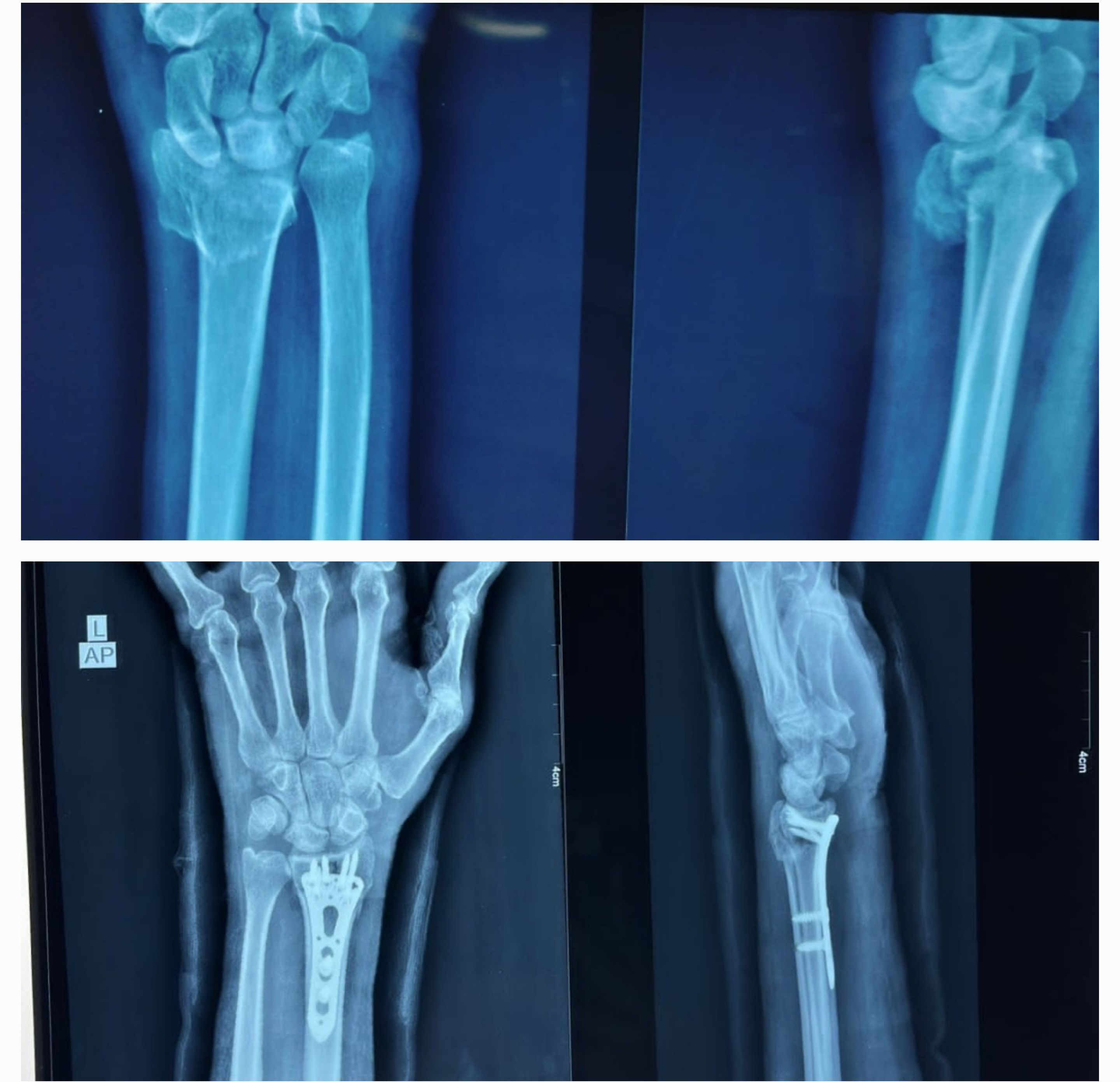
Surgical indications for distal radius fractures typically arise when the fracture is unstable, displaced, or involves the joint surface. Key surgical indications include: 1. Significant Displacement: More than 2 mm of intra-articular step-off (misalignment in the joint surface). Dorsal or volar angulation of more than 10-15 degrees. Radial shortening by more than 2-3 mm (can lead to ulnar impaction syndrome). 2. Comminuted Fractures: When the bone is broken into multiple fragments, surgery may be needed to restore normal alignment and stability. 3. Open Fractures: If the fracture involves a break in the skin, urgent surgical intervention is necessary to prevent infection and stabilize the bone. 4. Irreducible Fractures: When closed reduction (manipulation) fails to realign the bones, surgery is indicated. 5. Intra-articular Fractures: Fractures that extend into the joint often require surgical fixation to restore joint congruency and prevent arthritis. 6. Associated Injuries: Injuries involving soft tissue (ligaments, tendons) or neurovascular structures may also necessitate surgical repair. 7. Unstable Fractures: Even if initially reduced with a cast or splint, fractures that are unstable and likely to lose alignment may require surgical stabilization with plates, screws, or external fixation. 8. Failure of Conservative Treatment: If a fracture that was initially treated non-surgically shows signs of malunion (improper healing) or persistent instability, surgery may be required later. These indications aim to prevent complications such as malunion, joint stiffness, and arthritis, while ensuring optimal functional recovery of the wrist.


